A guide to the Noh mask
Kantan-otoko[邯鄲男]
A lifetime before lunch.
Rosei dreams of fifty years of splendour. Then his meal is ready. One mask must carry him through it all.
Name & identity
A lifetime in one face.
- Name
- Kantan-otoko 邯鄲男
- Reading
- かんたんおとこ
- Meaning
- The man of Kantan
- Type
- Young-man Noh mask
- Namesake role
- Rosei in Kantan
- Other role
- Sumiyoshi Myōjin in Takasago
Kantan-otoko gives a young man a face for a remarkably crowded afternoon. Its name means “the man of Kantan”; the furrows between its brows suggest that being young has not made life straightforward.
In the Noh play Kantan, the same mask carries Rosei through uncertainty, delight and the recognition that everything he has just possessed can vanish. What looks like a troubled face must also leave room for pleasure and understanding.
Reading the face
A face made for uncertainty.
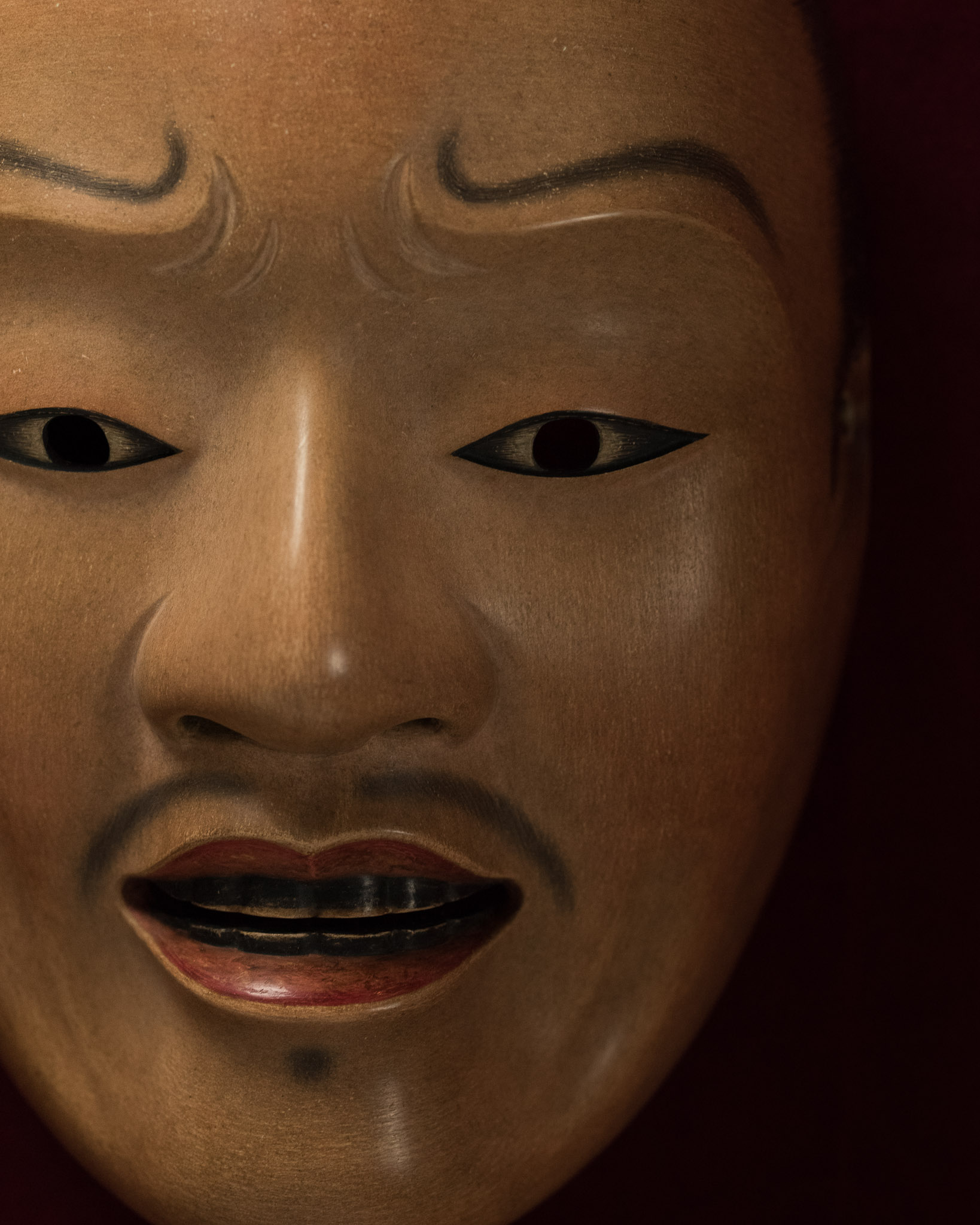
The mask has substance: broad cheeks, a tapering jaw and a prominent nose give it an oval outline, larger and heavier than the related Chūjō type. Long, narrow eyes sit beneath low, softly painted eyebrows. Two pairs of short creases rise between the brows, while shallow folds descend beside the mouth. Parted lips reveal both rows of teeth. The complexion varies from pale to yellowish tan, with a lightly painted moustache and, often, a small patch of hair on the chin.
These details help distinguish Kantan-otoko from its close relatives. Chūjō generally has heavier artificial eyebrows associated with high court rank, grooved upper eyelids and only an upper row of teeth. Kantan-otoko’s upper eyelids are smooth, and its eyebrows are less exalted: their blurred edges imitate cosmetic enhancement, rather than individual hairs. Its broader, firmer features also give it a less delicate presence. Yasuo Nakamura finds a more ordinary human strength here than in the aristocratic Chūjō and Imawaka.
Yet a firm face need not have a fixed mood. The Sano Art Museum catalogue describes Kantan-otoko as having an exceptionally neutral expression among male masks, suited to the changes before and after Rosei’s dream. “Neutral” in this sense need not mean vacant. The face must leave room for an actor to make anxiety, pleasure and understanding credible without changing masks.
Dream & performance
A reign ends. Lunch is ready.
Rosei begins his journey troubled by life and looking for guidance. At an inn in Kantan, he rests on a remarkable pillow. In his dream he is summoned to become a ruler, and the years unfold in peace, prosperity and courtly pleasure. At the celebration of his fiftieth year on the throne, he joins the dancing. Then the innkeeper wakes him: his millet is cooked. A reign has fitted into the preparation of lunch. The dream leads him to recognise the transience of glory and to return home with the understanding he had gone out to seek.
Still features, moving expression
This places an unusual demand on the performer. Rosei cannot simply look sorrowful from beginning to end. Nakamura stresses that the face must suit an earnest young seeker’s melancholy, yet become clear and refreshed after awakening. Udaka likewise emphasises that one mask remains in use up to the moment of recognition. The change belongs to the performance, even though the carved features remain still.
The carving makes that change possible. With the face inclined downward under an overhead light, the furrows between the eyes and around the mouth collect shadows, strengthening a discouraged or sorrowful look. Raising the face allows light into those recesses and can brighten the expression. The eyes and mouth work with these changes, much as they do in young-woman masks. A line that appears to record worry in a photograph becomes part of a moving range of expression on stage.
The divine role
When the young man becomes a god.
Kantan-otoko’s career extends beyond its namesake play: it also portrays Sumiyoshi Myōjin in the second part of Takasago. The human face can take on a divine presence.
The change did not require the worried brow to disappear. Nakamura observes that its short folds can also support a stern expression and thus a divine role. Marvin distinguishes the solemnity of masks intended for Sumiyoshi from the stronger anxiety or sadness of those selected for Kantan, while treating them as variations within the same type. The actor’s choice matters: the Sano catalogue places this family of male masks between aristocratic spirits and more explicitly supernatural faces, and notes that their use can depend on how the performer conceives the role.
History & attribution
The face has a lifetime, too.
An origin proposed by a scholar, a traditional attribution and the traces left on an individual object tell different kinds of history.
Different accounts of an origin
Udaka describes Kantan-otoko as designed specifically for Kantan’s leading role, whereas Marvin proposes an earlier origin in masks of gods. That proposed ancestry is distinct from its later adoption for divine roles on the Noh stage.
Nakamura places that expansion around the Momoyama period, linking it to a growing preference for brighter, more youthful divine figures. A comparatively human face could serve an aesthetic of refined beauty where a more overtly supernatural mask had previously been used.
An uncertain beginning
The earliest history is less certain than the name might suggest. Marvin argues that Kantan-otoko remained close to the earliest young-man masks, with Chūjō developing its standard form later. He points to an inscribed mask dated 1493 that resembles Kantan-otoko, while acknowledging that resemblance does not settle the lineage. The Kanze school’s model mask is traditionally attributed to Tokuwaka, but Marvin cautions against treating that attribution as proof that the fully standardised type already existed in the master’s lifetime.
The inscription dates an item of evidence; it does not by itself establish when the mask was carved or the type invented.
Lives recorded in the surface
Individual masks also carry histories of making and use. A Sano Art Museum example preserves numerous repairs; another revealed a maker’s inscription beneath its painted surface during restoration. Marvin’s catalogue example has fine horizontal chisel marks across the reverse and a pale, chalky finish that he attributes to loss of the paint’s glue binder. These are the histories of particular objects, rather than requirements of the type. They remind us that the face capable of sustaining Rosei’s imaginary lifetime has a material lifetime of its own.
The historical examples discussed here are separate from the mask photographed above.
The features stay still.The expression keeps moving.
Reading & reference
These four sources bring together performance, the mask’s visual character and the histories of individual objects. Differences in their accounts of its origins remain visible in the study.
- Udaka, M. The secrets of Noh masks (2018), p. 88.
- Marvin, S. E. Heaven has a face; so does hell: The art of the Noh mask (2010), vol. I, pp. 208–212; vol. II, p. 139.
- Nakamura, Y. Nō no men: Butai ni miru (1969), pp. 185–187.
- Sano Art Museum. Nōmen, kyōgenmen: Kanshō no shiori (1997), pp. 20–21, entries 19–20.