
A guide to the Noh mask
Hannya 般若
Between fury
and sorrow.

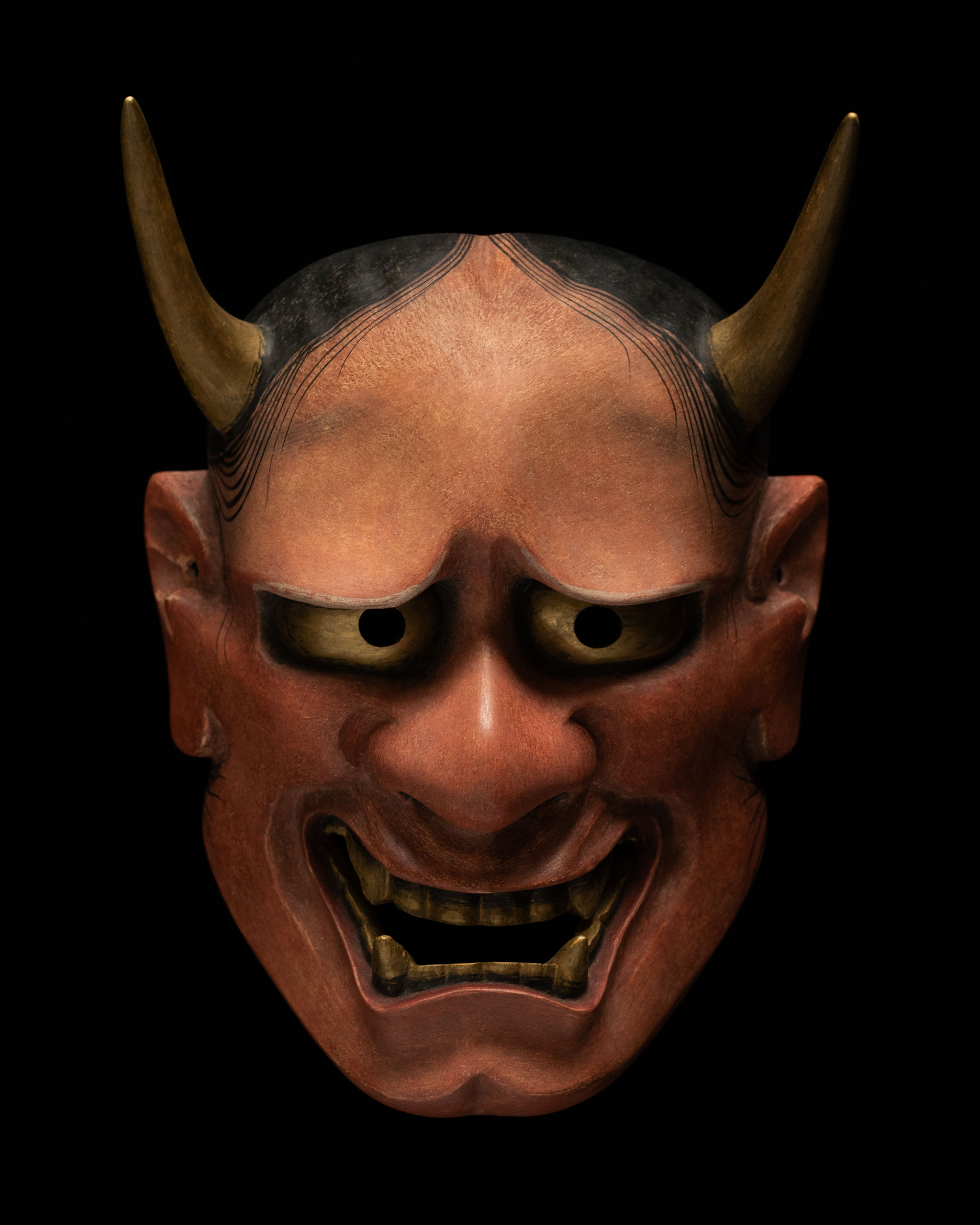
Horns, metal eyes and an open mouth give the Hannya mask its ferocity. Yet traces of the human face remain.
Begin with the faceReading the face
A demon.
A human trace.
Look past the horns.
Hannya represents a female demon, or a woman transformed into one through jealousy, anger and sorrow.
It belongs to the female vengeful-spirit, or onryō 怨霊, masks of Noh. It is also described as an oni mask. Its dramatic character holds more than a single emotion.
Two horns, large oval metal eyes and an open mouth establish its demonic appearance. The mouth contains metal teeth and two pairs of fangs, one above and one below.
The painted eyebrows and hair introduce another quality. Nakamura interprets these features, including the scattered or disordered strands, as feminine elements: a continuing connection with the woman beneath the demonic face.
Expression & movement
The same face.
A different feeling.
Slightly raising or lowering the mask can alter its apparent expression, creating impressions of joy or sorrow. The horns, mouth and eyes remain the same; the angle changes how they are seen.
In performance, that shifting appearance allows jealousy, anger and sorrow to inhabit the same carved face.
The mask on stage
The moment of transformation.
Hannya appears in specific dramatic roles, often for a later or transformed figure.
Aoi no Ue 葵上
The spirit of Rokujō no Miyasudokoro first wears Deigan 泥眼, then Hannya for her transformed demonic form. The change has been interpreted as a progression from jealousy to a demonic state.
Dōjōji 道成寺
Hannya may be used for the transformed figure, but it is not obligatory. Shinja 真蛇 can be chosen instead.
Kurozuka 黒塚
Also known as Adachigahara 安達原, this play uses Hannya for the later female-demon role.
Origins & name
An unmistakable face.
An uncertain beginning.
Hannya’s early history is less definite than its appearance and dramatic uses. Earlier horned demon masks were probably known as Ja 蛇, “Snake” or “Serpent,” and Shinja, “True Serpent.”
One interpretation holds that Hannya developed from these earlier masks after Noh had become established, taking on a distinctly Noh-like character. This remains an interpretation of its development.
The name is uncertain too. Nakamura states that its origin has no established explanation. Traditions connect the mask or its name with Hannyabō 般若坊, but do not confirm that this figure created the mask or supplied its name.
The demonic features command attention.
The human trace holds it.
Reading & reference
- Nō no men: Butai ni miruNakamura, Y. · 1969
Noh masks: Seen on stage - Negoroji no nōmenTanabe, S. (editor) · 2002
Noh masks of Negoroji Temple - Nōmen, kyōgenmen: Kanshō no shioriSano Art Museum · 1997
Noh and Kyōgen masks: A guide to appreciation - e-MuseumNational Institutes for Cultural Heritage · Noh masks formerly owned by the Konparu family
- The-NOH.comCaliber Cast Ltd. · Noh masks database