
Noh mask types: faces and stories
I’m still drafting this page. I’ll add more sources and refine the details as my understanding grows.
A young face may belong to an immortal. A warrior may return as a ghost. The face gives us a first clue; the play takes us further. Here, I’m exploring women, men and spirits, with Kyōgen’s comic faces alongside them.
Choose a face to begin with
Follow the faces that catch your eye. I’ve grouped them into four starting points, with room for the masks whose stories lead from one section into another.
Women’s masks: similar faces, different lives
Magojirō gives us a particularly personal place to begin. Tradition says Kongō Magojirō based the original mask on his wife, who died young. Knowing that story, I find myself looking longer at the eyes and mouth: a face made for the stage, connected to the memory of a real person.
Beside Ko-omote’s full, rounded cheeks, Magojirō appears more slender, with longer eyes and a sharper nose. Waka-onna offers another variation, with less rounded cheeks. These are the differences I enjoy looking for: small changes that make closely related faces feel distinct.
There is more here than youthful beauty. Zō-onna is used for female deities and spirits, while Fukai and Shakumi portray mature women, including mothers suffering separation or loss. Following these faces takes us through different ages and experiences—and sometimes from a human character into a spirit.
Image notes & sources
Men’s masks: the warrior with a flute
Men’s masks bring us young courtiers, warriors and elders. A familiar human face may also belong to a ghost.
Atsumori is the play I keep returning to. A warrior and flute player, killed at sixteen, returns as a ghost to the man who ended his life. Kumagai has become a monk and now prays for him. I find the flute difficult to forget: it gives the young warrior an interest, a skill, a life beyond the battle.
Jūroku is one of the masks used for Atsumori’s ghost. Chūjō also portrays warriors and courtiers. Then there is Dōji: a boyish face used for gods and immortals. He gives us a natural way into the spirits.
Image notes & sources
Spirit masks: gods, ghosts and transformation
I have a deep admiration for Yorimasa, the warrior, poet and archer. In Yorimasa, his ghost recalls his final battle. In Nue, the creature he killed returns to ask for prayers. Even the creature from the hero’s story gets to tell us what became of it.
Hannya is the well-known horned face of anger and suffering. Nearby are Namanari, portraying a woman becoming demonic, and Shinja, whose protruding jaw and earless face suggest a more pronounced serpent form. These faces give us different ways of looking at transformation.
Deigan is the face I’d pause with here. Her gold eyes and teeth interrupt an otherwise recognisably human appearance. Depending on the play, she can portray a grieving ghost, a jealous woman or a dragon goddess. I find her beautiful because those quiet features can carry such different lives.
Image notes & sources
Kyōgen: comic faces and unexpected tenderness
Kyōgen’s humour grows from speech, movement and recognisable human behaviour. Most roles use the actor’s own face; masks appear for particular characters.
Usobuki’s puckered mouth can belong to an octopus or a mouse spirit. Oto gives us a comic woman’s face, while Saru brings a monkey onto the stage. Even these boldly drawn faces have quite different lives in performance.
In Utsubozaru, a lord demands a monkey’s skin for his arrow quiver. When its trainer raises a stick, the monkey mistakes the movement for a cue to perform. Its familiar routine moves the trainer and helps persuade the lord to spare it. That is the moment I want to remember when looking at Saru.
Image notes & sources
Okina: a dance for peace and prosperity
The smiling elders of Okina bring another purpose to the stage. Their dances offer prayers for peace and prosperity, giving these masks a particular place in Noh’s ritual life.
Hakushikijō (Okina) is the pale-faced mask worn by Okina; Kokushikijō is the dark-faced mask worn by Sanbasō. Deep wrinkles, curved eyes and separately attached lower jaws make these faces especially distinctive.
Chichi-no-Jō connects us to an earlier three-part form of the ritual. I find these faces especially moving when I think of their dances as wishes for a community’s future.
Image notes & sources
From the collection
-
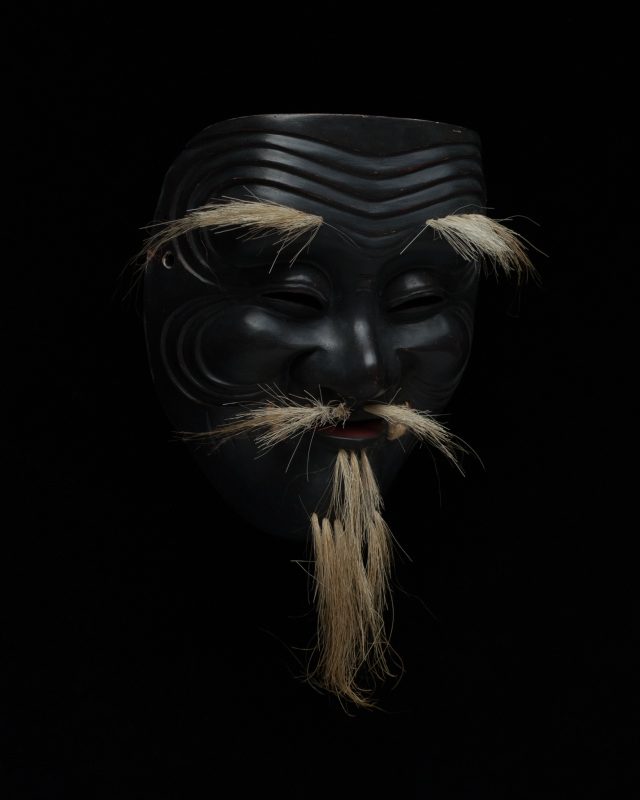
Kokushikijō
黒式尉
€ 290,00 AvailableIn your cart · View cart
View & purchase — Kokushikijō / 黒式尉 — Noh Mask